

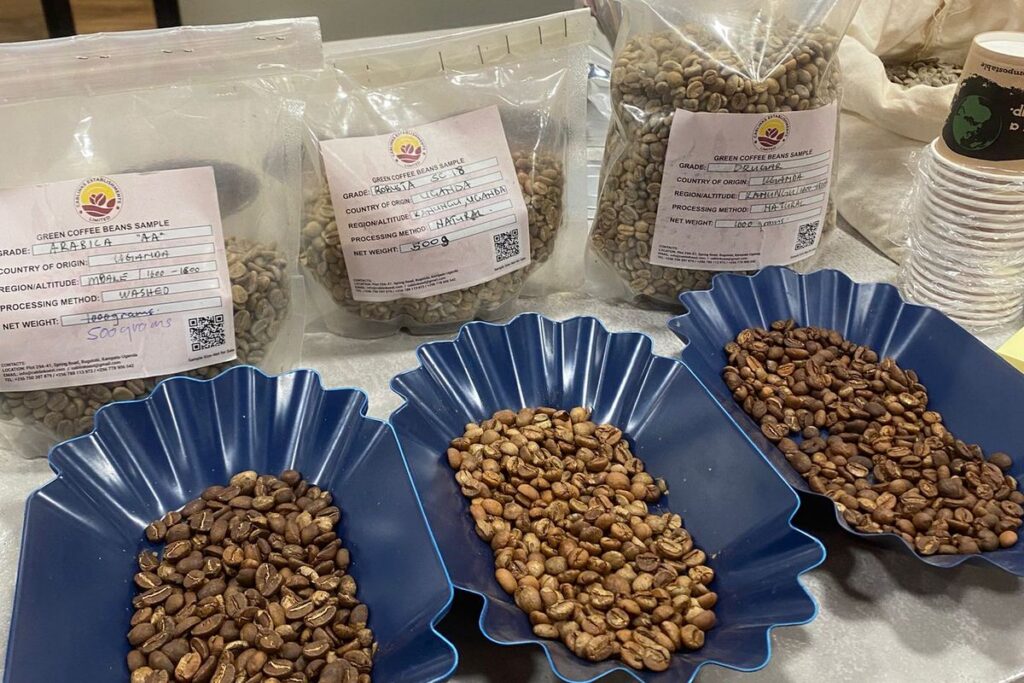
A sample is a promise. Your job is to check whether the shipment can keep it. A good sample is not just a good cup. It is a lot you can repeat, document and receive in the volume you need.
This checklist is for roasters, importers and quality teams evaluating Ugandan coffee. It works for Arabica and Robusta, washed and natural.
1. Ask for a sample that represents the lot
Give the exporter the full specification: species, region, grade, screen, process, crop year, volume and packaging. Ask for a sample from the lot you will actually receive, not a hand-picked show sample.
Ask how the sample was drawn. A probe sample, a warehouse sample and a production sample can tell different stories.
2. Record what arrives
Note the date, weight, packaging, lot number and condition. Take photographs before you open the bag. If the sample arrives damaged or damp, stop and ask for a replacement.
3. Check the green beans
Look at colour, smell, uniformity and defects. A clean, fresh smell is a good sign. Musty, mouldy or chemical smells are not. Check the screen distribution and the moisture reading.
You do not need a laboratory to spot obvious problems, but you do need a consistent method. Use the same light, the same tray and the same defect reference for every sample.
4. Cup with a fixed protocol
Cup the sample with the same roast profile, water, dose and temperature you use for other origins. Score fragrance, flavour, acidity, body, sweetness, clean cup, aftertaste and balance. Write the notes down.
A sample that tastes good only at one roast level is not a stable product. Try a second roast, especially if the lot is for espresso or a dark roast.
5. Test repeatability
Ask for the lot size, the number of bags available and the harvest date. Ask whether the exporter can repeat the same specification in the next shipment. A great sample from a tiny lot is useful, but it may not be a supply programme.
Ask for the exporter’s quality process: how the lot is graded, colour sorted, cupped and packed. A documented process is a better guarantee than a single good cup.
6. Put the approved sample in the contract
Reference the approved sample, lot number and quality specification in the contract. Agree what happens if the shipment does not match. Keep a sealed reference sample in a cool, dry place.
What to check
| Area | What to check | Question for the exporter |
|---|---|---|
| Green bean | Colour, smell, defects, moisture | What is the measured moisture and defect count? |
| Screen | Distribution around the main screen | What percentage sits on each screen? |
| Cup | Acidity, body, sweetness, clean cup | Can you share the cupping notes and score? |
| Lot | Size, crop year, warehouse | How many bags are available and when? |
| Repeatability | Process and next shipment | Can you repeat this specification? |
Red flags
- No lot number or crop year.
- No moisture or defect information.
- A sample that cannot be linked to a specific lot.
- Reluctance to share quality documents.
- A price that is far below the market without a clear reason.
- A promise of a large volume from a lot that is clearly small.
How to store a reference sample
Keep the approved sample in a sealed bag or jar, away from light, heat and strong smells. Label it with the lot number, date, grade and contract reference. If a dispute arises, the reference sample is the baseline for the conversation.
Where CabLinks fits
CabLinks supplies samples from documented lots and cups and grades before shipment. We can share the lot details, quality results and packing specification, and we quote FOB and CIF.
Next step: Request a sample set, or read how we cup and grade.
Related reading: how Robusta screens work and Arabica DRUGAR, A, AA and PB.